
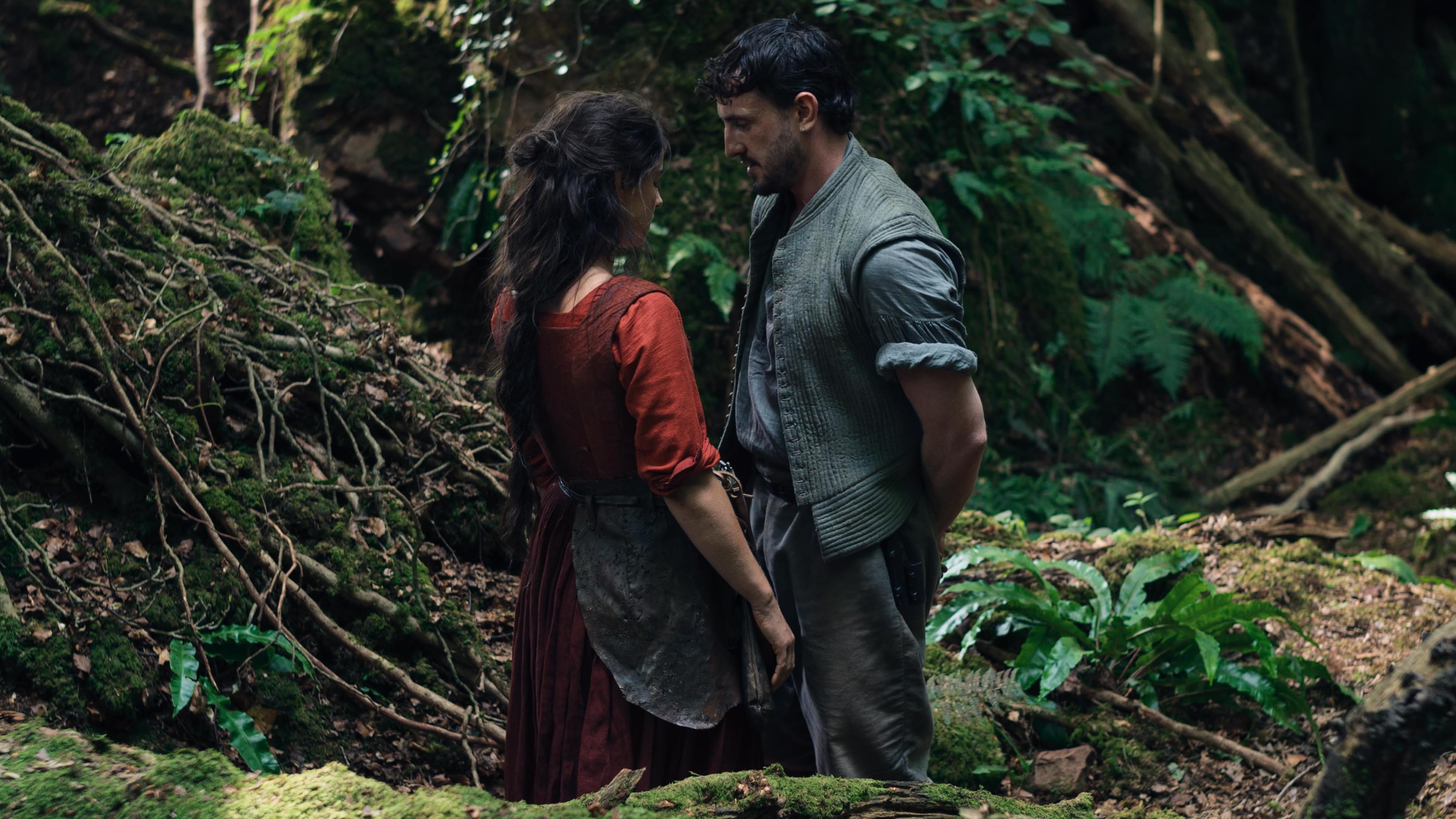
Actor and award-winning director Chloé Zhao (Nomadland) helms a soft, verdant period drama about William Shakespeare’s family life and the tragedy that may have inspired his greatest work.
“In William Shakespeare’s day, the names Hamlet and Hamnet were interchangeable…” This is the text card that ushers us into the film, a statement Zhao uses to frame the context of this story. Hamnet explores the family life of William Shakespeare and attempts to connect personal tragedy to the inspiration behind one of his most famous works.
The film works masterfully as historical fiction and, in some ways, benefits the audience more depending on how little you know about Shakespeare’s personal life. Even if you know everything, the brutal authenticity of the performances is enough to keep you locked in from start to finish.
Hamnet is an emotionally charged meditation on the beautiful fragility of life and the transcendent power of artistic expression. From its opening frames, there’s an aching tenderness in the way the story unfolds, a reminder that art is often born in the spaces where love, loss, and longing collide. Co-written by author Maggie O’Farrell and director Chloé Zhao, the film allows Zhao to shape this story in her image, posing the questions she most wants to explore.

Zhao is simply in top form here. She commands a cast at the height of their abilities to create something beautiful, raw, and cathartic. There is a level of mastery and confidence in her direction that is bold and refreshing. Some scenes are framed like stage play compositions, with the visual language shifting from wide landscapes to tight, intimate close-ups. She knows when to hold on her performers and when to let the camera move. She also makes bold choices during the film’s most heartbreaking moments. choices that leave you gutted as she forces us to sit in a moment that feels violently interrupted.
While the story centers on Shakespeare and his world, the true lead of the film is Agnes, Shakespeare’s grounded, fiercely loving wife. Jessie Buckley is the beating heart of this story, keeping our blood pumping (and tears flowing) from beginning to end. Buckley commands the screen with a performance that is both dominating and sincere. The raw humanity she puts on display is deeply mesmerizing.
Agnes is a free spirit, someone who bucks convention and remains deeply connected to her roots and her deceased mother. Her mother’s teachings in herbal lore reinforce her nature as a healer and maternal figure. She is tough, free, and unafraid to be herself. This captivates young Latin tutor Will, and from there we watch their romance blossom. There is brilliance in the film’s decision to spend so much time with the couple, because we get to experience the beauty of life through their eyes. On the surface, you might think the movie is about death, but it is truly a film about life.

Tragedy serves as the emotional core of the story, but there can be no death without life and what makes a death tragic is when the life lost is full of promise, hope, and love. Life has no meaning if it is not lived, and by letting us live with Agnes, Will, and their children, the story becomes real and tangible in a way that hurts. We go on this emotional journey alongside the characters, culminating in a cathartic third act that perfectly punctuates the film’s thesis.
Jacobi Jupe deserves special praise. He takes on a challenging role and handles it with the depth and humanity of a seasoned professional. His performance dictates the emotional weight of the film, and with that responsibility on his shoulders, he more than delivers. His brother, Noah Jupe, appears in the film as well, an inspired casting choice that pays off beautifully.
Paul Mescal is excellent as a young William Shakespeare. He shows us sides of the character we’re not accustomed to seeing. I appreciate the film’s approach: we watch him struggle to maintain a normal life, the burden to create leaving him restless and unsatisfied at home. His rise happens off-screen, because that’s not the point of this story. When he is on screen, he appears as a father and husband, and we judge him accordingly.

All of these performances are elevated by the stunning cinematography of Łukasz Żal. His framing of the forest landscapes is gorgeous, and the third-act imagery is simply perfect. Watching this film feels like witnessing a team come together, each part raising the others up to form a well-oiled machine. This is a cast and crew at the top of their game, and it shows in every frame.
Ultimately, Hamnet is a film about the power of art. Art would be meaningless if it had nothing to say. If a piece of art cannot speak to someone, then what is it truly? A life lived is a beautiful life, and to be remembered is to live after death. Hamnet makes you understand why life is so beautiful, only to rip your heart out so that you may reach catharsis with its characters.
A truly magical film.
4.5/5


Leave a Reply