
Season 2 of Daredevil: Born Again is bigger, bolder, and better than Season 1 in every way. It is a triumphant return to form for the Devil of Hell’s Kitchen, and a season that earns every emotional beat it delivers.
When we pick up in Season 2, Mayor Wilson Fisk has won. New York is in a dark period. Fisk is running a frightening propaganda campaign to mask what is essentially a dictatorship, where anyone who dares oppose the regime is detained without due process by the anti-vigilante task force. Daredevil is public enemy number one, and his allies (like Karen Page) are being hunted right alongside him. Matt and Karen can’t show their faces. They can’t afford to be identified. But they are still finding small ways to hit back from the shadows, chipping away at the machine one piece at a time. Things are as desperate as they have ever been. Can they hold on long enough to see cracks start to form? Resist. Rebel. Rebuild.

The season is hard-hitting with a relentless pace from beginning to end. The action is vastly improved over Season 1, with a focus on stunt work and cinematography that makes every altercation feel visceral and raw. Philip Silvera’s work behind the stunt coordination is as strong as it has ever been, and there are plenty of standout fights to satisfy even the most dedicated fans of the action. The first two episodes are the slowest of the bunch, dealing with leftover threads from Season 1 and establishing the key plot points that drive everything that follows. Think of episodes one through three as Act One. Once you clear episode two, the show takes off and never slows down. Episode four is absolutely wild, and from there we build to a crescendo that carries all the way through the finale. If I had to pick a complaint, there is some sloppiness in the visuals of episode one that briefly took me out. But it is corrected so fast that I barely noticed, and as the story gets more intimate, the visuals grow increasingly reminiscent of the Netflix era. It starts to feel very familiar in the best way.
What makes this season work beyond the central conflict is how well it uses its ensemble. Minor characters are given room to breathe, and the show gives us genuine reasons to care about the newer faces. In a season where the soul of New York is at stake in a war between Daredevil and Kingpin, it is nice to see the toll that takes on both sides.
Angela del Toro’s storyline speaks to the timely nature of the anti-vigilante task force and how they are abusing their power against ordinary New Yorkers. We see inside the Fisk campaign through the eyes of Daniel Blake, a man being seduced by power and influence, while BB Urich, determined to honor the legacy of her uncle by being a true reporter, starts to sense there is more to Daniel than simply being a puppet. Her story is about fighting the propaganda machine with facts, giving voice to what happens in the shadows. Then there is Buck Cashman, a Fisk loyalist who takes a liking to Daniel and tries to take him under his wing. He had little to offer in Season 1, but Season 2 gives him a real personality. It is his relationship with Michael Gandolfini’s Daniel Blake that peels back his layers, exposing who he truly is. Arty Froushan is great in this role as I really enjoyed what he did with Buck this season.

Kirsten McDuffie represents the law in a season where the law itself is under siege. Under Fisk’s regime, the legal system is bent entirely to his will. He holds vigilante trials that are a complete farce; a public display of his stranglehold on the courts and a direct jab at his arch-rival. It falls to McDuffie to fight the good fight, to preserve the sanctity of justice in a time of lawlessness. Is the system broken beyond repair? It is a question the show keeps asking, and it never lets you settle on an easy answer.
This season has two wildcards: characters who enter the war with their own agendas. The first is Bullseye. Benjamin Poindexter. The man behind the shot heard ’round the Kitchen. It was his murder of Foggy Nelson in Season 1, at the manipulation of Vanessa Fisk, that was the inciting incident for this entire war. Now, in Season 2, he is seeking redemption. And when I say that, I mean the Bullseye version of redemption. He is not simply becoming a good guy. He has a twisted worldview, and what redemption means to him is very specific. Bullseye enters this season, injecting a sense of chaos and fun into every scene he occupies. There is a sequence that opens episode four that is absolutely wonderful; very comic book in its portrayal of his mental state and skill set. I love this story for Dex.
The second wildcard is the mysterious Mr. Charles, a figure who appears to work for the CIA and wields real global power. He operates as a foil to Fisk, and Matthew Lillard is absolutely fantastic in the role. Mr. Charles is a familiar archetype: the shadowy figure lurking in the background, but we have never seen Matthew Lillard do this type of character before, and that is what makes him so unique. Lillard has a particular flavor to his performances that is ever-present here, and it makes him a genuine bright spot in a very dark season.

Krysten Ritter’s Jessica Jones is back after seven years, and she is not pulling any punches. The fear of including a character like Jessica in such a packed season was real. I mean, it would have been easy for her to just show up and leave. But the show gives us a fantastic reason for her being here and genuinely explores what she has been up to since we last saw her. Seven years is a long time. A lot can happen to a person. The Jessica we meet in Daredevil: Born Again is still the Jessica Jones we know and love, but she has lived more. She is in a different place. In a season where vigilantes are being hunted, Jessica becomes our lens into what it means to be one with an exposed identity. What decisions has she had to make? What sacrifices? Ritter has not lost a single beat. She is fantastic, and this season will absolutely make you want to see more of her story.
Wilson Fisk begins Season 2 in complete control, at the absolute top of his game. The question the show asks is: what happens to Kingpin when he has won? Is winning enough, or will his pride, his hubris, his obsession get the better of him? Vincent D’Onofrio is as captivating as ever. Fisk’s ego reaches a godlike level this season; at one point, he is literally compared to Zeus. He perverts the law to his whim, silences anyone who dares defy him, and has everything he has ever wanted, yet still craves more. His lust for power is insatiable. This godlike symbolism culminates in a moment where someone tells him to have hope, and he scoffs at the idea. Things WILL happen, he says. That need for control, that hubris, it may just be his downfall. Because while Fisk views himself as a deity, a god among men, he is far more similar to the dastardly rulers of history, like Nero, who was willing to burn Rome to the ground when the people were no longer satisfied with his rule. His wardrobe reflects his journey this season, with more white incorporated as he sheds the mayoral disguises and slips back into his Kingpin persona. White overcoats over black suits. Black overcoats over white suits. The duality is always present.

Vanessa Fisk’s story is draped in Greek mythology. She is compared to Europa, and her wardrobe reflects that storyline beautifully. But she is also haunted by dreams, or perhaps premonitions, of a fateful confrontation with Benjamin Poindexter. Is she Europa, or is she Pandora? By letting Bullseye out of the proverbial box, she unleashed all of the chaos that defines this season. She is the inciting force behind the war for New York, and the show never lets her off the hook for it.
And then there is Matt Murdock. Matt starts the season fully immersed in his role as Daredevil. In the past, we have seen him forsake his civilian identity out of despair. We have seen him forsake the Daredevil persona out of guilt and shame. But now he is embracing the vigilante life in the face of a corrupted system: resistance is the only path forward. His journey this season is complex and compelling. He is locked in a war with his greatest enemy, but the obsession they share has warped both of their perspectives. Matt blames the state of the city entirely on Kingpin. Fisk blames the state of the city entirely on Daredevil. It is an unhealthy, all-consuming obsession that has been building for years, and it is full of hubris and pride on both sides.
But Matt is also forced to confront his faith. He is still haunted by the sin he committed in Season 1: he tried to kill Bullseye, and because of that, he feels unworthy. He begins to rediscover himself and his values, realizing he may be part of the problem, and the only road to salvation, for himself and for his city, is through mercy, grace, and sacrifice. The intense, thought-provoking conversations that defined the Netflix series are back. The exploration of Matt’s morality and beliefs is stronger than ever.
The main themes of the season are grace and mercy. Can Matt show mercy? Can he hand out grace? And at the end of it all, will he receive what he feels is God’s grace in return?

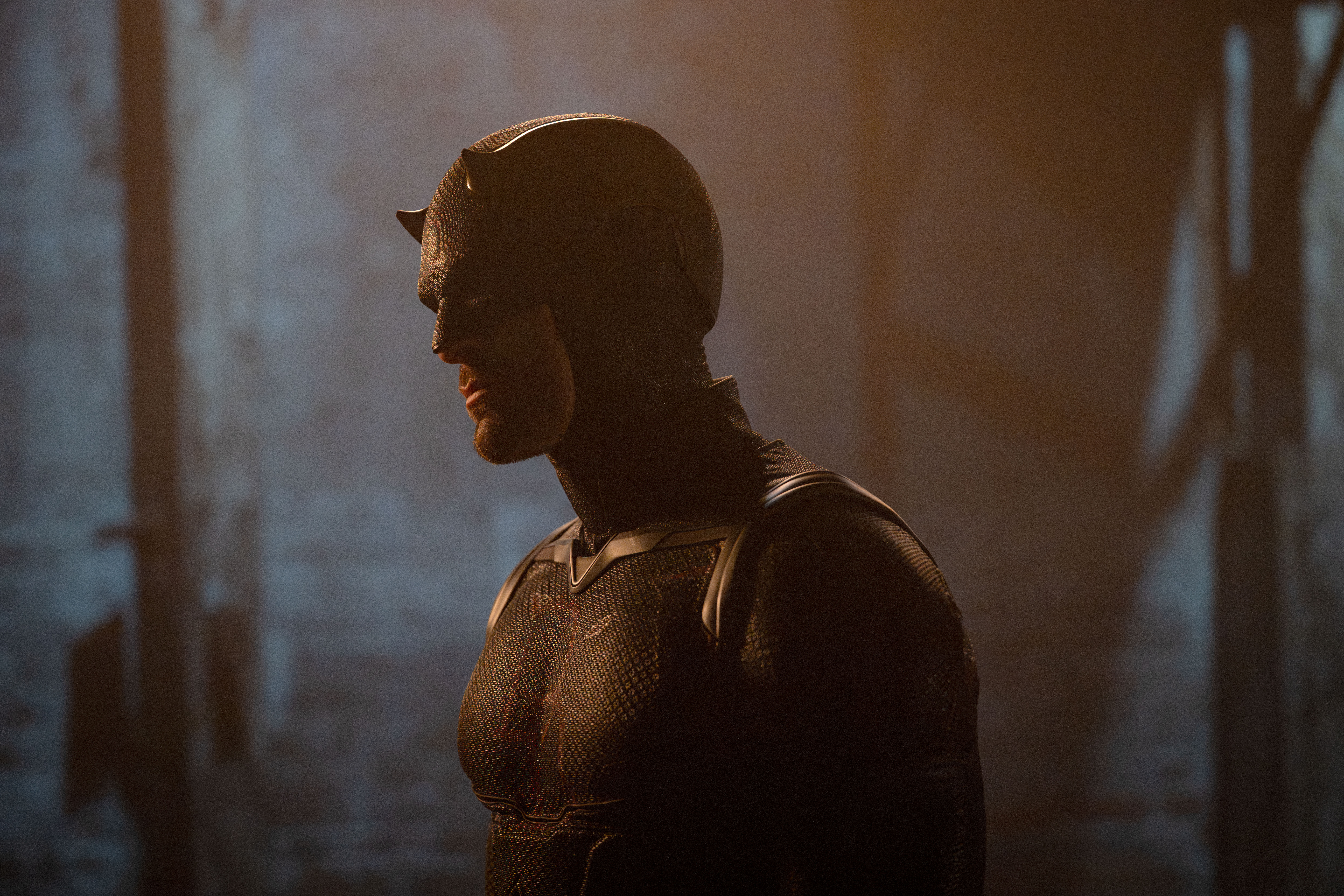
Matt’s journey is also told visually through the Daredevil suit. He begins the season wearing his Season 1 suit painted entirely black, emblazoned with the trademark DD logo for the first time. The black helps him operate in the shadows, and the DD is a symbol of rebellion, of hope. He is no longer hiding who he is: He is Daredevil. But as the season progresses, the black paint is scuffed away and the red bleeds through. It symbolizes Matt’s willingness to bleed for his city and, more importantly, shows that he has finally come to terms with both halves of himself: The darkness and the light. Daredevil has always been about dichotomy. Matt is a lawyer who truly believes in the justice system, and a vigilante who breaks bones and takes the law into his own hands. Eventually, those two worlds must collide. The suit is a visual representation of that collision.
Emily Gunshor has done an outstanding job with the costume design this season. Beyond the masterpiece that is the black suit, she tells us so much about each character through what she chooses for them to wear. The look of Daredevil’s allies invokes rough and ragged resistance. The evolution of Angela Del Toro’s clothing as she rises up. The different outfits of Jessica Jones representing her growth. The wardrobe of the Fisks telling us everything about their inner lives. All of it is intentional. All of it is meaningful.
Karen Page’s role in Season 2 is expanded, and she is fully engaged in the narrative. She trains, goes undercover, and has to fend for herself on multiple occasions. She is, essentially, public enemy number two. Her relationship with Matt is back on, and it is a big part of their story this season: a love story during wartime. If the circumstances were different, this would be a life worth living. But they are both chaotic people, and chaos has a way of finding them. Her work is vital. She takes everything Daredevil uncovers and fights to get it to the people. She is a boots-on-the-ground freedom fighter, a former journalist trying to expose corruption and give light to what happens in the shadows. In Season 1, she did what Karen does best and ran after Foggy’s death. Now she is back and ready to face the pain she left behind.

On the technical side, this season delivers on every front. The Newton Brothers are back, and they continue to elevate the haunting score they developed for the first season. They reuse familiar themes and motifs, amplifying and exploring them in exciting new ways. I really love how they use the sound when different characters are woven into the story, especially with Jessica Jones. Some really fun stuff there. The visual language of the series continues to build through camera movement, aspect ratio changes, and lighting that define specific characters with precision. The red light that bleeds into Daredevil’s scenes, the cold blue of Bullseye, the blinding white of Fisk, all of it is still present, and all of it is used perfectly. One of the central themes of this season is masks, and the use of mirrors to represent identity and duality is a recurring visual motif that rewards close attention.
What truly sets Season 2 of Daredevil: Born Again apart from Season 1 is that it openly embraces everything that came before. The spirit of the Netflix series lives on. We get callbacks and references to that era of the show, giving this season a warm sense of familiarity while still feeling like something completely new. All the things you loved about the original Daredevil return. The show fully acknowledges the history of these characters and honors what came before, while incorporating new twists and turns that make it feel fresh.
Daredevil: Born Again Season 2 is a triumphant return to form for the Devil of Hell’s Kitchen. A season that earns every emotional beat, rewards longtime fans, and raises the bar for Marvel Television. The Devil doesn’t just return; he is, at last, born again.



Leave a Reply