

From April to June, Sony will be re-releasing their live-action Spider-Man films in theaters. Starting today, this series on themontyverse.com will be reviewing them each week.
When Sam Raimi’s Spider-Man was released in the summer of 2002, it was a true phenomenon as the first film to make an unadjusted 100 million dollars on its opening weekend. Though Blade and X-Men preceded it, it was really the film that showed studios that comic book movies could really work. Admittedly, I was nowhere near old enough to be able to see this movie when it first came out, so when it was announced that Spider-Man was going to be playing in theaters again, I immediately bought my ticket. And even though I’ve seen the film several times before today, and will see it several times after today, there was something that was really special about getting to watch it on a big screen for the first time.
For anyone that may need a refresher, the film follows Peter Parker (Tobey Maguire), the least popular kid in high school who gets bit by a radioactive spider while on a field trip. He wakes up the next day to discover he has superpowers, he longs after his neighbor Mary Jane (Kirsten Dunst), he comes into conflict with Norman Osborne and his alter ego The Green Goblin (Willem Dafoe) who happens to be the father of his best friend Harry (James Franco), with great power comes great responsibility, you get it. You’ve seen it. You know the story, and even if you don’t, yes you do. It is the superhero origin story; it codified everything that we have seen in 21st century comic book movies. I guarantee that you could watch any MCU or DC film, and in some way find a connection to this movie.

When the lights went down and Danny Elfman’s main title score began, I immediately felt a rush run through my body. There is honestly nothing that compares to hearing that score accompany those titles, and it makes me wish that more movies nowadays, not just comic book movies, did this more often. A score that gets you instantly locked in, tells you everything you need to know about the tone of the film, and what to expect in this upcoming face-off between hero and villain. All of it is captured in the music alone, and each subsequent track builds upon the main titles. Motifs in the opening come back later with different instruments playing the notes, tempos are changed to make scenes more somber or exciting. I cannot overstate how great this score is; I listened to it again as soon as I got home.
This is also one of the best casts ever assembled for a comic book movie. There are some cast members who aren’t quite up to the level of others, and of course Dafoe is chewing so much scenery I’m shocked his teeth aren’t painted, but everyone fills their role well. Maguire’s puppy-dog demeanor makes him someone that we as the audience can immediately sympathize with, yet there is always something in his expression that lets us know that getting bullied every day hurts him and makes him angry. When that anger comes out in moments like the iconic “I missed the part where that’s my problem” line, not only do we as the audience get it, we’re almost on his side. Kirsten Dunst makes the most of what she’s given, and Mary Jane would end up having a lot more to do in the sequels, but it’s a good introduction to her as a character. Rosemary Harris takes what could just be the parental guide in Aunt May and turns her into the emotional lynchpin of the movie, and honestly the whole trilogy. Willem Dafoe and J.K. Simmons as Norman Osborne and J. Jonah Jameson respectively are two of the all-time greatest casting decisions ever made. Simmons is so iconic in his role that they couldn’t even recast the character in the Tom Holland films, deciding it would be better to just bring back Simmons. Dafoe, meanwhile, is the only person who could pull off the insanity of the Goblin and make it fun and terrifying. He walks the razor’s edge of the part of the brain that decides whether something is comedy or horror so perfectly.

Even the things that I thought might not hold up as well on a theatrical viewing didn’t take anything away from the experience. Are some of the effects dated? Sure, but that adds to the charm, and those CGI effects are blended really well with a lot of practical effects and stunt work. Is the dialogue hokey? Yes, but it’s also a very memorable script, and the actors sell it. It blends well with the world that Raimi creates, which is heightened and over-the top. If a villain in the MCU shouted “we’ll meet again, Spider-Man!” after a battle, yeah, it probably wouldn’t work, but it’s a perfect match for this film’s tone. Spider-Man really does feel like a product of 2002, and I mean that as a good thing.
This is going to seem like a bit of an odd tone shift in this review, but this was a very important film for a lot of reasons. It was the first major summer release of 2002, a year that directly followed one of the most deadly terrorist attacks in American history. The first teaser for Spider-Man even got pulled from theaters because it prominently featured the Twin Towers. The attitude of America at the time was very patriotic, and media wanted to reflect the idea that we were all coming together and that we were stronger together. That’s why there are moments in the film like “you mess with Spider-Man, you mess with New York,” or why you could get pretty drunk if you took a shot every time an American flag appears on screen. But while those elements might have been played as tongue-in-cheek nowadays, they’re features of the film that are played with complete sincerity. What I appreciate about Raimi and screenwriter David Koepp is that it would have been really easy to just stick to that “America, F yeah!” mentality, but they don’t shy away from the darkness.
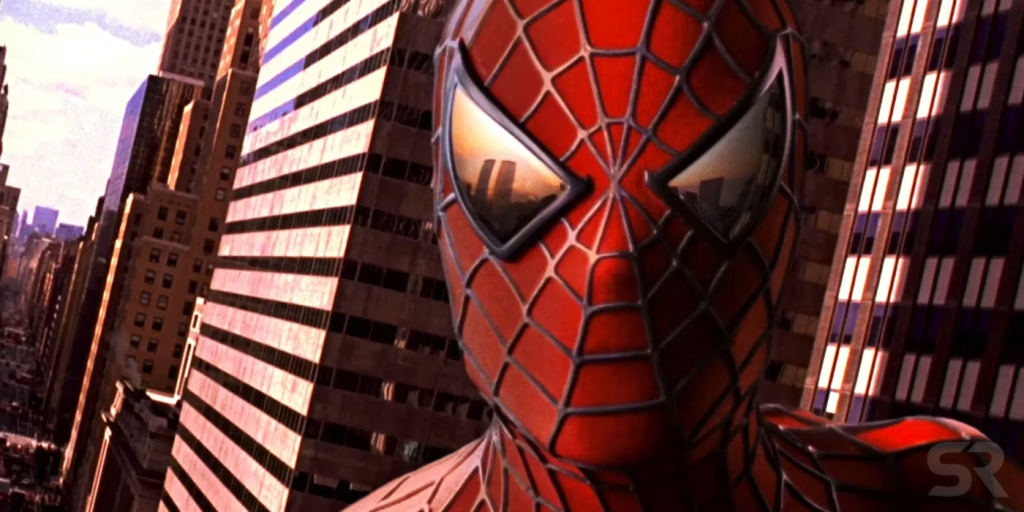
Before helming Spider-Man, Raimi was best known for horror films, particularly the Evil Dead trilogy. We see these sensibilities explicitly come into play throughout the film, as there are way more jump-scares in the film than I remember. But what I appreciate is that Raimi and Koepp are really able to tap into the post-9/11 anxiety that America was feeling, the news cycle that peddled fear to sell papers, the desire to want to do more. Even the concept of “with great power comes great responsibility” can be seen as a direct refutation of what America was getting itself into. What I think Raimi understood is that audiences needed something optimistic but with an edge to it, and that is exemplified in the third act. The first half is the epic, iconic “Spider-Man must choose one or the other” comic book storyline, and he’s saved not by his own power, but by the power of the people. The second half is far more dramatic, set in an abandoned house, and falls more in line with the horror sensibilities of Raimi. It’s a legitimately scary scene at points, especially when we see just how beaten down our hero gets by the end of it. The triumphs that a hero should achieve aren’t achieved, and Peter ends the film forced to live a lie to his best friend and reject the girl that he’s been after the whole film. It’s an ending that has been replicated in other comic book movies, even other Spider-Man movies, but it has never been done as effectively as it’s done here.
Spider-Man remains one of the best comic book movies ever made. Its iconic moments are still just as thrilling to watch, and it is a really interesting time capsule. It does make me wish that every comic book movie had this much sense of personality and voice — too often it feels like comic book movies are more interested in the characters in our world than their world, even though the latter is nearly always more fascinating. It will be playing in theaters this whole week, and I cannot recommend enough that if you have the chance to go see it on a big screen with great sound, please do it. I’m very excited to revisit all the Spider-Man movies, and I’m very excited for you to join me as we, as the poster’s tagline puts it, go for the ultimate spin.

Leave a Reply