
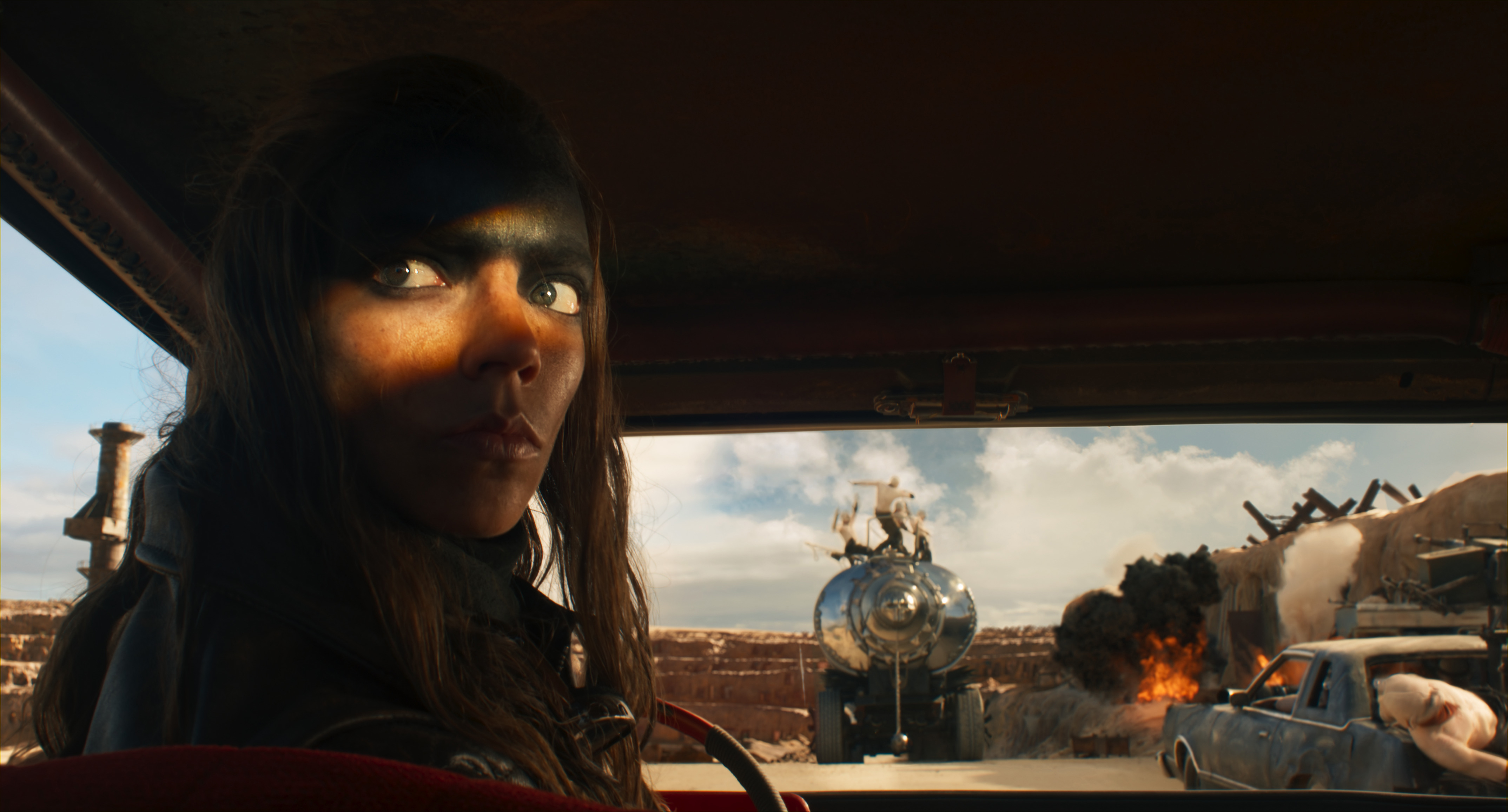
30 years after the conclusion of his Mad Max trilogy, George Miller delivered something that nobody expected, least of all from a man who had just turned 70 years old; a sequel/reboot to the franchise with 2015’s Mad Max: Fury Road. The idea of a reboot-quel was not anything new, particularly in the franchise-obsessed pop culture sphere of the mid-2010s, but it was Miller’s new take on a story he created in the 70s that strapped audiences in for a wholly unique theatrical experience.
Fury Road is so simplistic in its story, a feature instead of a bug. Two hours of a car chase where the most consequential action is a driver making a left turn, the film was far more focused on visual language and storytelling through cinematography, sound, and editing. The characters spoke minimal dialogue, but Miller’s precise command of his actor’s facial expressions allowed for audiences to connect with them. Despite the film being called Mad Max, the character that audiences walked away from Fury Road talking about was Imperator Furiosa, played by Charlize Theron. A new character created for this film, Miller saw just how much audiences connected with her and her story, and knew there was more that needed to be told with her.
Nine years later, as Miller approaches 80, he has delivered on that promise with Furiosa: A Mad Max Saga. A prequel to Fury Road and full of nods and easter eggs to it, the film chronicles the time of the early years of Furiosa right up until Fury Road begins. While many thought Theron would return, Miller opted to recast the role instead of digitally de-age (a smart choice), and Anya Taylor-Joy steps into the title role. Joining her in this new chapter of the saga is Chris Hemsworth as the villainous Dementus that snatches Furiosa from the land of abundance that she comes from.

Furiosa is likely to be somewhat of a divisive film, especially for diehard fans of Fury Road. It is important to know that despite existing in the same universe, featuring some of the same characters, and having similar visual aesthetics, the films are radically different. This should not come as a shock to anyone familiar with the Mad Max franchise as a whole, as every film thus far has been distinct from the others, but audiences may find the slightly slower pace of Furiosa off-putting. The film does not immediately throw the audience into the action, choosing instead to world-build and focus on the political machinations of this post-apocalyptic hellscape.
Taylor-Joy, in fact, does not appear until an hour into the film; for the first half of the film, Alyla Browne commands the screen as Furiosa, doing incredible work with so few lines of dialogue. Every turmoil the character goes through plays out through Browne’s eyes, contrasting the stoicism at work on the rest of her face. When Taylor-Joy does appear, she matches Browne so perfectly that it’s crazy remembering they are not the same person in real life. Taylor-Joy has spoken about the difficulty regarding the role, and watching what she goes through in this film, it is understandable, but she commands the screen in a way that so few actors can.
Mirroring her on the complete opposite end of the spectrum is Chris Hemsworth, who appears to be having the most fun in a role he’s ever had. The Mad Max franchise has always contrasted its aloof protagonists with bombastic villains, and Hemsworth may be the craziest yet. Long hair, an even longer beard, gold teeth, and an over-the-top accent, Hemsworth finds a way to be even more exuberant than the incredible visual landscape that surrounds him. A mix of intimidating and hilarious, it would not be surprising if Warner Bros pushed him for a rightfully deserved Best Supporting Actor nomination.

Visually, Furiosa is just as breathtaking as its predecessor, at some points exceeding it. Miller has clearly grown as a filmmaker even in his old age, creating some of the most incredible stunt work ever put to film. When the first major car chase begins and the performers begin their death-defying stunts, the energy in the theater was that of everyone wanting to applaud but being stunned into silence. Miller is famous for his love of practical effects, and combines them so seamlessly with the computer-generated ones that it’s tough to tell where one ends and the other begins. Miller smartly keeps the audience paying attention to the actors during these sequences as to give a real sense of stakes to each scene. Because only a handful of characters from this film appear in Fury Road, the audience is constantly on the edge of their seats, wondering either if a character is going to survive a moment, or holding their breath to see how another is going to get out of a situation.
The place where audiences may find disappointment with Furiosa is in its pacing, but again, it’s important to remember that this is a far different film from Fury Road. The first major car chase that was mentioned up above features Taylor-Joy as Furiosa, who again, does not appear until an hour into the two and a half hour runtime. The film is told in chapters, the same way an epic would be, and follows a five-act structure as opposed to the traditional Hollywood three-act structure. Once the car chases begin, the film’s foot is on the gas and never lets up, but it really takes its time to immerse the audience in the world. This might not appeal to the people who enjoyed the fact that Fury Road gave so little information about its universe, but for people such as myself, it not only serves to make Furiosa more interesting, but it retroactively heightens the enjoyment of Fury Road. Character decisions in that film that might not have made sense 9 years ago are suddenly given clarity and meaning. Small moments suddenly become big with the context of this film. Essentially, it does what a prequel should do: tell its own story while supporting the story that will chronologically follow it.

There are a couple of minor sticking points and logical gaps in the film, but nothing that significantly detracts from the quality of filmmaking. Miller’s acumen had always leaned towards the production elements of a movie instead of script; so long as the story makes enough sense, the focus will always be on the sensations brought on by the visuals and the sound. Even if audiences don’t connect with it initially, Furiosa will be a classic held up for years to come, and go down as another incredible entry in the Mad Max saga.

Leave a Reply