
A Rebellious Biopic Fit for a Culinary Rebel
Anthony Bourdain was larger than life. By the time most of us came to know him, he already seemed completely formed. He was this effortlessly cool chef, writer, and traveler with the cigarette-weathered voice, razor-sharp wit, and seemingly endless curiosity about people, food, and the world around him. How do you tackle the life story about a man as complex as he was and do it justice?
Matt Johnson’s Tony takes an interesting approach, as it is interested in a much more difficult story: what did Anthony Bourdain look like before he knew how to be Anthony Bourdain?

That question is what makes Tony such a fascinating biopic, because in many ways, it’s also an argument against the traditional biopic. Rather than attempting to condense Bourdain’s entire life into two hours, Johnson focuses almost entirely on one formative stretch of his youth in Provincetown. Even then, the movie is intentionally loose with history, condensing roughly three years of Bourdain’s experiences into a romanticized summer in 1975 that reshapes real events, relationships and people into something closer to a coming-of-age story than a literal historical recreation.
Normally, that kind of fictionalization would make me nervous in a biopic. Those kinds tend to distort facts for the sake of glamorizing or sensationalizing the subject. Yet with Tony, that is kind of the entire point. Tony is less interested in faithfully documenting the facts of Anthony Bourdain’s life than it is in trying to understand the emotional journey that eventually creates the man we knew. There is something strangely fitting about taking someone who became famous partly through the mythology he constructed around his own life and making a movie that knowingly mythologizes the period when that mythology first began to take shape.
The Man Before the Myth
This approach feels uniquely suited to Matt Johnson. Whether it is the faux-documentary filmmaking of Operation Avalanche, the controlled chaos of BlackBerry, or the completely insane Nirvanna the Band the Show the Movie, Johnson has always been interested in people desperate to convince the world that they are something before they actually are that something. His characters bluff, exaggerate and perform confidence, sometimes forcing reality to bend around the version of themselves they desperately want everyone else to see.

Tony might be one of the most interesting extensions of that obsession yet. Johnson takes everything we already know about the Anthony Bourdain mythology and almost works backward from it. Instead of presenting the confident, worldly man audiences recognize, he gives us a kid who is insecure, arrogant, romantic, angry, ambitious, and desperately trying to convince everyone around him that he already knows exactly who he is. The irony is that almost everyone around him can see that he does not.
Dominic Sessa completely understands that distinction, and his performance is one of the biggest reasons the movie works for me. He never feels like he is doing an Anthony Bourdain impression. Sessa is not constantly dropping recognizable mannerisms or trying to remind us of the man Bourdain eventually becomes. Instead, he plays someone who occasionally gives us glimpses of that person almost accidentally. You can see the curiosity, humor, rebelliousness, and romanticism beginning to emerge, but they are still buried underneath the insecurity of a 19-year-old constantly trying on different identities and hoping one of them finally fits.
There is something wonderfully uncomfortable about watching Tony walk into a room acting like he is already the smartest person there while Sessa’s face quietly tells you that Tony is terrified everyone is going to discover that he is not. Johnson builds so much of the movie around that contradiction, and his camera language gives Sessa room to live inside it. The premise of the film allows Sessa the freedom to inform the character of Tony with his own choices while not slavishly doing a Bourdain impression and he takes that opportunity and runs with it.

Johnson’s earlier work often uses documentary-inspired camerawork to make you feel as though you have accidentally wandered into something happening in real time, but Tony feels more intimate and subjective. The close-ups and long lenses are constantly searching Sessa’s face, turning small reactions, hesitation and embarrassment into part of the storytelling. It feels less like we are observing Anthony Bourdain from the outside, like we are slowly being pulled inside the perspective of a kid trying to figure himself out.
Order, Chaos and the Men Tony Could Become
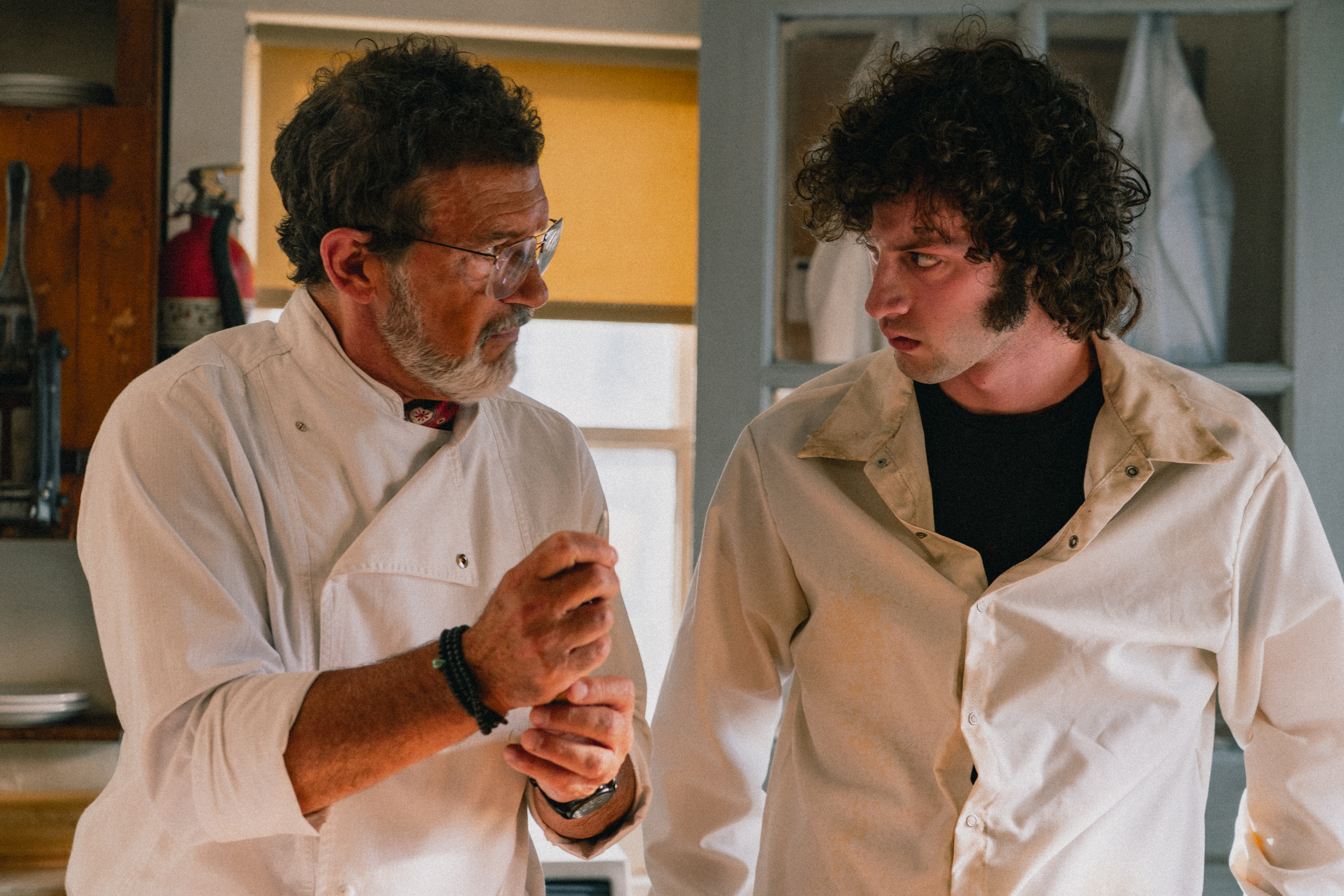
The people around Tony become different possible answers to the question of who he wants to be and nowhere is that clearer than in the contrast between Antonio Banderas’ Chef Ciro and Leo Woodall’s Sal.

Banderas is fantastic as Ciro, a composite mentor figure who represents discipline, craftsmanship, and an identity that has actually been earned. He brings this rugged nobility to the character that makes him immediately believable as someone Tony would secretly admire. You can tell this man has lived, but more importantly, you can tell he has a code. He has standards, expectations, and a belief that confidence means nothing if it wasn’t earned through hard work.
The fact that Banderas actually knows his way around food adds another layer of legitimacy to the performance. There is a quiet physical confidence in the way he carries himself in the kitchen that never feels like acting. He does not have to convince us that Ciro belongs there because every movement suggests that he already does. For a movie so interested in Tony performing adulthood, that makes Ciro an especially powerful counterpoint because he never needs to perform anything. He just is, and there is a graceful beauty to that.

If Ciro represents order, Leo Woodall’s Sal represents chaos. Woodall is quickly becoming one of those actors whose presence immediately jumps off the screen, and between this and Tuner, he is having a hell of a run. Sal is charming, dangerous, funny and intoxicating because he represents almost everything Tony thinks freedom is supposed to look like. He is appetite without restraint, pleasure without consequences and confidence without apology.
The two characters almost become opposing philosophies sitting on either side of Tony. Ciro represents discipline, craft and earned identity, while Sal represents appetite, recklessness, freedom and hedonism. One is effectively telling Tony that he has to become something, while the other is telling him that becoming anything at all is another restriction. Tony spends much of the movie suspended between those ideas because each offers a version of adulthood that seems more complete than the one he currently understands.

That dynamic becomes even more interesting because Sal also seems to absorb some of the darker impulses we associate with Bourdain’s later struggles. He becomes almost a sin-eater for the character (which Ciro describes him as in the film), carrying the danger, addiction and self-destructive freedom that Tony finds seductive. There is an interesting question buried in that decision about whether the movie externalizes too much of Bourdain’s darkness instead of allowing Tony himself to fully own it, but Woodall is good enough that Sal never feels like a simple devil-on-the-shoulder archetype.
Falling in Love with the Kitchen
Emilia Jones gives the movie another necessary counterbalance as Nancy. At first, Tony makes you think this is primarily going to be a love story about Tony falling for her, and that relationship absolutely matters, but I think the movie is ultimately doing something more interesting.
Nancy sees through Tony in a way most of the other characters do not. She recognizes how much of his confidence is performance, which makes their relationship less about her completing him and more about forcing him to confront the distance between the person he says he is and the person he actually is.

The beauty in Tony is it knows the importance of Nancy, but I think the real love story in the film is not Tony falling in love with Nancy. It is Tony falling in love with the kitchen and, maybe in a strange way, beginning to learn how to love himself through it.
The kitchen gives him something his carefully constructed intellectual persona cannot: a place where identity has to be earned. Tony cannot simply tell everyone he is talented. He has to do the work, learn the station, survive the heat and prove that he can actually make the food. A kitchen is brutally honest and when you step into one, you can’t lie your way to the top.
That becomes one of the most interesting ideas running through the movie. Tony spends much of his life believing identity is something you announce to the world, while the kitchen slowly begins teaching him that identity is something you practice.

It also gives him a community. Tony understands that food was never simply the thing Anthony Bourdain cooked. It became the way he connected with other people. The cooks, outsiders, artists, weirdos and strangers sitting around a table were eventually as important to Bourdain’s legacy as anything he actually put on a plate.
At the End of the Road
Provincetown becomes essential to that discovery, and I love the way the setting is treated throughout the movie. It never feels like an attractive historical backdrop that could have been swapped out for any other seaside town. It feels like a character.
There is something almost mythic about Tony reaching this strange little community at the edge of the country and suddenly discovering entirely new ways of living, working and understanding other people. Johnson himself described Provincetown as feeling like the furthest place you could go without actually leaving America, and the geography fits Tony almost perfectly. He is physically at the end of the road while standing at the beginning of everything that will define the rest of his life.

The production design and cinematography give the town a tactile, slightly imperfect texture rather than turning the 1970s into some pristine nostalgic postcard. The restaurants feel hot and cramped, the streets feel lived in, and the whole environment has a romantic energy without feeling overly polished.
That authenticity matters because this is ultimately a movie about environment reshaping a person. Provincetown feels like the place where Tony first realizes there are more versions of adulthood available to him than the ones he arrived with. It is where food becomes something beyond sustenance, work becomes something beyond obligation, and strangers become people worth understanding.

In many ways, the Provincetown Anthony Bourdain discovers here contains the DNA of the entire worldview he would eventually take around the globe.
Mythologizing a Man Who Mythologized Himself
That gets to why the movie’s historical inaccuracies did not bother me nearly as much as I expected them to. Tony is full of contradictions. It is a biopic that does not faithfully recreate its subject’s life, a love story that is not really about romance, and a coming-of-age movie about someone who would not actually become famous until much later.
It is also a film about Anthony Bourdain that openly acknowledges that the Anthony Bourdain audiences think they know was, at least partly, a persona Bourdain himself created. Perhaps most interestingly, the movie mythologizes the exact period in which Anthony Bourdain began creating his own mythology.

There is a legitimate conversation to be had about where emotional truth ends and historical invention begins, especially when you dramatize the life of someone who left behind so much writing and footage in his own voice. The movie is not journalism, and viewers looking for an exact reconstruction of Bourdain’s early life may understandably have a harder time accepting some of its choices.
What works for me is that Johnson does not seem interested in pretending this is the definitive Anthony Bourdain story. He is imagining the private person who might have existed before the public character. That distinction is important because Tony never claims to explain Bourdain. If anything, I think the movie is smarter when it refuses to.
It allows us to watch a confused and insecure young man encounter food, work, love, discipline, temptation and community, then asks us to recognize little fragments of the person he might eventually become. There is something much more human about that than treating every moment of his youth as destiny.
A Life Before It Became a Tragedy
That is also why the movie’s optimism hit me as strongly as it did. We know how Anthony Bourdain’s story eventually ends, and the film obviously knows that we know, but Johnson refuses to use that knowledge as an emotional weapon.
There are countless ways a lesser biopic could have weaponized our knowledge of Bourdain’s death, turning every moment of sadness, recklessness or isolation into some painfully obvious piece of foreshadowing. Tony largely refuses that temptation because doing so would rob this younger version of Bourdain of something fundamental: possibility.

The film allows this period of his life to belong to the kid experiencing it. It does not ask us to watch the beginning of a tragedy. It asks us to watch the beginning of a life, with all the uncertainty, stupidity, joy, ego and promise that should come with that.
Dominic Sessa is outstanding, Antonio Banderas brings enormous warmth and authority, Leo Woodall continues to prove he is one of the most exciting young actors working right now, and Matt Johnson once again finds a completely unexpected way into a story that could have easily become another conventional prestige biopic. Between Nirvanna the Band the Show the Movie and now Tony, Johnson has two of my favorite films of 2026, and this continues what I loved about BlackBerry: his ability to take a period-specific real-world story and make it feel unmistakably his own.
By the end, I did not feel like I had watched a movie about Anthony Bourdain becoming famous. I felt like I watched Tony begin to understand why he wanted to live the kind of life Anthony Bourdain eventually would. The film romanticizes that beginning, condenses it and reshapes it, but in doing so it captures something emotionally compelling about a young man discovering that the person he wants to become cannot simply be performed into existence.
He has to actually become him.



Leave a Reply