
CHAPTER I — PRESS START
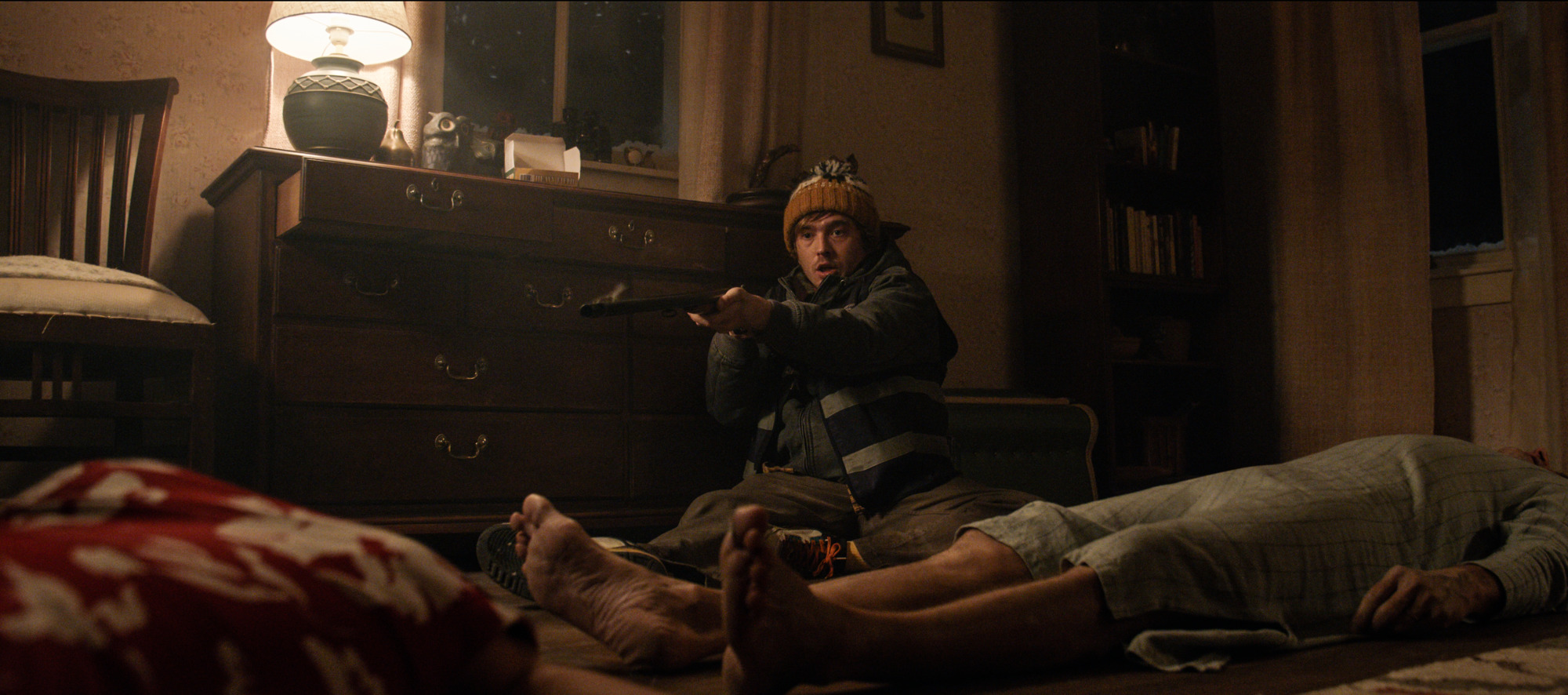
Zach Cregger’s Resident Evil understands something that video game adaptations often struggle with: faithfulness is about more than recreating familiar characters, locations and images. Sometimes the most important thing to adapt is how the game actually feels to play, and that is exactly what Cregger attempts here. Rather than directly retelling one of the games, Resident Evil tells an original story built around Bryan, an ordinary medical courier who finds himself trapped in a nightmare he is hilariously and terrifyingly unprepared to survive.
Cregger has described the movie as something happening alongside the world and events of Resident Evil 2, but his real interest is clearly less about recreating that game’s story than translating its survival-horror mechanics into cinematic language. Resource management, limited ammunition, healing, weapon progression and the constant movement from one increasingly hostile environment into another are all baked into the structure of the film. The movie is designed around the feeling that the situation is getting worse faster than Bryan can adapt to it, and that approach allows Cregger to make something inspired by Resident Evil without simply recreating familiar iconography.

In many ways, Bryan essentially functions as the player. From almost the moment the nightmare begins, the movie is built around escalation as he moves forward because he has no other choice, constantly entering new spaces that present new problems, new creatures and increasingly ridiculous levels of danger. Cregger has talked about wanting the film to keep moving, keep Bryan vulnerable while continually escalating, and you can feel how defined that philosophy was throughout production. What makes the approach work is that Cregger surrounds himself with filmmakers who understand how to execute that vision and make every department feel like part of the same larger idea.
CHAPTER II — THROWN INTO HELL
Cregger’s approach works because Bryan is not an action hero. He isn’t Leon Kennedy, and he isn’t suddenly going to pick up a gun and transform into Rambo. He is a regular guy with a regular job and practically no survival experience who is thrown into a situation so far beyond his abilities that simply making it another ten feet can feel like an accomplishment. The movie allows him to learn, but it does so gradually. Bryan makes mistakes, he panics, he misses and he gets hurt, so when he becomes better at surviving, it feels like something he has learned through experience rather than an arbitrary transformation into somebody the character was never supposed to be.
Austin Abrams is phenomenal at selling every part of that progression. His performance is incredibly physical, and Abrams commits his entire body to it. You feel Bryan becoming more exhausted as the night progresses, the panic in the way he moves, the hesitation before decisions and the increasingly instinctual way he responds all help sell how experience slowly replaces his confusion. Because Bryan spends so much of the movie isolated, Abrams carries an enormous amount of the film without another performer there to play against, yet he never loses the character’s everyman quality.

That becomes especially important when the movie leans into humor. Resident Evil is undeniably horrific and frequently grotesque, but it is also very funny, and most of that comedy arises naturally from situations rather than feeling shoehorned to break the tension. There is something inherently funny about watching an otherwise normal person attempt to process increasingly insane circumstances, and Abrams has excellent comedic timing. Cregger also has a talent for filling his movies with strange, memorable people, so even characters who occupy comparatively little screen time tend to feel like they existed before they wandered into this particular story. They have quirks, rhythms and personalities rather than simply functioning as exposition machines or future bodies for whatever monster happens to show up next.
The humor never undermines the horror because the movie knows when to pull it away. Cregger has said earlier cuts were considerably funnier and that he removed a substantial amount of comedy after test audiences felt there was too much of it. That decision is easy to understand watching the finished film because Resident Evil walks a surprisingly delicate line. The comedy provides release, but it never prevents the movie from becoming genuinely stressful, and the longer we spend with Bryan, the more desperately we want him to survive. Every mistake becomes frightening because we understand how limited his options are, while every new environment carries the possibility that the next thing waiting for him might finally be something he doesn’t know how to overcome.

There is also more going on with Bryan than simple survival. Cregger said he incorporated some of his own uncertainty around fatherhood into Bryan’s story, and that personal element gives the character an emotional conflict that exists before any monsters arrive. Bryan isn’t simply trying to survive. He has a life he hasn’t fully figured out yet and responsibilities he hasn’t completely accepted, so suddenly being faced with the possibility of never returning to that life forces him to reconsider what actually matters. That makes responsibility one of the more interesting ideas running underneath all of the blood and chaos. Bryan’s journey is obviously about becoming more competent, but it is also about persistence, control and learning what is worth fighting your way back toward.
CHAPTER III — ALWAYS KEEP MOVING
If Bryan functions as the player, Dariusz Wolski’s camera becomes the controller. The cinematography is one of the film’s greatest strengths because the camera doesn’t merely document the action, it actively participates in it. Sometimes it feels detached, observing Bryan stumble his way through the chaos, while other times it moves almost like a third-person game camera, carefully maintaining our understanding of Bryan’s relationship to the environment and whatever threat is hunting him. The film even has fun slipping into first-person perspective at times without ever feeling like it is desperately trying to remind you that this is based on a video game.
More importantly, the movement has purpose. There are stretches where the camera seemingly refuses to stop moving, matching Bryan’s momentum and allowing the tension to continually build around him. Yet even during the film’s most chaotic sequences, Cregger and Wolski maintain a strong sense of geography, so we understand where Bryan is, where the danger is and, most importantly, how little room exists between the two. That spatial clarity is vital to what the movie is attempting because survival horror depends on vulnerability. If the audience can’t understand the environment, chaos simply becomes visual noise, whereas Cregger allows us to understand the space well enough that we can anticipate the danger before Bryan necessarily can.

The camera doesn’t just show us Bryan’s journey; it helps create the feeling that we are moving through it with him. That becomes one of the most successful ways the movie translates the sensation of playing Resident Evil without turning its visual language into a gimmick.
CHAPTER IV — WELCOME TO RACCOON CITY
That sense of immersion is strengthened considerably by Tom Hammock’s production design. The snowy Raccoon City is an inspired visual choice, and the decision to physically transform Prague locations with artificial snow, American storefronts, wrecked vehicles and environmental destruction gives the world a practical foundation that does an enormous amount to sell the movie’s atmosphere.
The snow becomes the perfect canvas for Cregger’s visual insanity because blood explodes against white surfaces, colored lighting cuts through otherwise cold environments, darkness becomes harsher and movement becomes easier to isolate. A setting that could have simply looked like another destroyed American city instead develops a visual identity entirely its own, and that identity works perfectly with the heightened style Cregger is pursuing.

The practical environments are equally important because Hammock isn’t merely recreating recognizable franchise imagery. The environments are designed around Bryan’s journey and the movie’s obsession with escalation. Places begin relatively mundane before gradually becoming uncomfortable, threatening and eventually completely insane. Every new environment feels almost like Bryan has entered another level, one with its own visual identity and its own problem he has to solve before moving forward.
That progression helps the movie achieve something crucial to Cregger’s approach. The audience doesn’t simply watch Raccoon City deteriorate, we experience that deterioration geographically, moving alongside Bryan as each new space reveals that the situation is somehow worse than the one he just escaped. The practical production design makes that progression feel tangible, and it is a huge part of why the movie is able to sell its immersive vision.
CHAPTER V — CONTROLLED CHAOS
All of this movement puts an enormous amount of responsibility on editor Joe Murphy. A movie built around nearly continuous escalation could very easily become exhausting in the wrong way because if everything operates at maximum intensity, eventually nothing feels intense at all. Resident Evil understands that, and Murphy knows exactly when to let the movie breathe and, just as importantly, how long that breath should last before the next nightmare begins.
The pace is fast, but it never feels thoughtless. There are moments where the movie allows tension to dissipate just enough for you to relax before immediately beginning to tighten the screws again. Instead of constantly screaming at the audience, the movie understands that anticipation can be just as effective as impact, and that rhythm also gives the humor room to function. The movie frequently uses situational and physical comedy to cut through its more intense sequences, especially through Bryan’s reactions to the increasingly absurd nightmare surrounding him, but those moments never feel like the film is abandoning horror. They feel like brief opportunities to release pressure before the tension begins rebuilding.
There is certainly plenty of pressure to release because Resident Evil does not hold back on body horror or gore. Cregger has described it as the most violent movie he has made, and that becomes apparent very quickly. Bodies are mangled, mutated and destroyed in frequently disgusting ways, but the film’s horror isn’t dependent entirely on gore or jump scares. Its most effective weapon is vulnerability, because what consistently makes the horror work is that Bryan never feels completely equipped to deal with what the film throws at him.

The result is a movie where the gore, tension, comedy, editing and physical performance all feed into the same central idea. The film may appear chaotic, but the filmmaking rarely is. There is a strong sense of control behind the madness, and that makes the escalation feel deliberate rather than overwhelming for its own sake.
CHAPTER VI — THE TRICK IS THERE IS NO TRICK
That control is also where Resident Evil distinguishes itself from Zach Cregger’s previous films. Both Barbarian and Weapons derive part of their unpredictability from their willingness to shift perspective and radically restructure themselves around the audience, whereas Resident Evil does almost the opposite. Cregger locks us beside Bryan and pushes forward, and there is no elaborate structural trick hiding underneath the movie because the trick is that there isn’t one.
Cregger doesn’t need to constantly pull the rug out from under the audience because this film has a different goal. The unpredictability comes from discovering what waits in the next room, around the next corner or at the end of another seemingly impossible stretch of Bryan’s journey. In that sense, the restriction becomes the experiment, because instead of asking how many different perspectives Cregger can use to disorient us, Resident Evil asks how much terror, comedy and visual creativity he can generate while keeping us attached to one increasingly exhausted man.

The answer is quite a lot. Resident Evil is a heart-pounding experience from beginning to end, but what impressed me most is how deliberate the chaos feels. Cregger clearly knows the movie he wants to make, and the cinematography, editing, production design and performances are all working toward the same goal. At the center of all of it is Austin Abrams, who is funny without turning Bryan into a joke, emotionally vulnerable without becoming melodramatic and physically committed enough that every encounter looks like it takes something out of him. This is the kind of performance that should make significantly more people take notice of just how talented Abrams is.
Zach Cregger has now made three horror films that feel radically different while still carrying his fingerprints. Resident Evil may be the most straightforward of them structurally, but it is also arguably his biggest exercise in pure filmmaking momentum. He doesn’t adapt Resident Evil by asking how many recognizable things from the games he can put on screen. Instead, he asks a much better question: how do you make an audience feel like they’re the one holding the controller? For nearly ninety relentless, disgusting, hilarious and anxiety-inducing minutes, Resident Evil finds a pretty great answer.


Leave a Reply