

In the grand scheme of franchises, one of the more interesting case studies of the 21st century has been the Planet of the Apes. After a disastrous attempt in 2001 by Tim Burton to “reimagine” the series, director Rupert Wyatt and screenwriters Rick Jaffa and Amanda Silver found an immense amount of success with their 2011 reboot Rise of the Planet of the Apes. Disconnected from anything that had come before it, but still a clear homage to the original film series from the 60s and 70s, Rise saw box office success and found two interconnected stars: incredible visual effects and motion-capture technology, and the performer of the film’s central ape Caesar, Andy Serkis. Although Serkis had received praise for his motion-capture performance as Gollum in The Lord of the Rings trilogy, his turn in Rise was a sight to behold. The success of the film led to an increased budget and new director in Matt Reeves for the 2014 sequel Dawn of the Planet of the Apes, an even bigger box office hit, making over 700 million dollars. For a franchise that had been dead on arrival not 13 years previously, it was now praised not only for its entertainment value, but also for its profound thematic content. While its follow-up in 2017 War for the Planet of the Apes did not do as financially well as Dawn, it was still critically acclaimed and concluded the trilogy in a way that audiences found satisfying. Apes had gone from an auteur’s biggest failure to date to a franchise with a stellar reputation.
Naturally, the studio was going to want to continue the Apes films in some capacity, and seven years later, the follow-up Kingdom of the Planet of the Apes has finally released. Stepping into the director’s chair is Wes Ball, director of The Maze Runner trilogy, and penning the script is Josh Friedman, who worked with Jaffa and Silver on Avatar: The Way of Water. Set many generations after the events of the Caesar Trilogy, Kingdom sees multiple clans of apes established throughout the land, while humans have regressed into their most feral. When Noa (Owen Teague) has an interaction with a human girl named Mae (Freya Allen), he inadvertently sets off a chain reaction that causes his home to be destroyed and his friends and family to be captured by another clan of apes. Noa sets off, accompanied by Mae and an ape ally named Raka (Peter Macon) who still follows the teachings of Caesar, to find his family, all the while debating the same questions that the previous Apes films ask. What does the relationship between ape and human look like, who has power and what should be done with it, what does it mean for one species to evolve, what responsibilities to apes have to other apes and to humans? The film asks and answers a lot of these questions very succinctly, but never in a more meaningful way than any of the films that came before it.

From a visual standpoint, Kingdom is incredibly impressive. The environments and the apes both look amazing, and it’s worth noting that the budget for the film is around 150 million dollars. While high, it’s on the lower end of modern blockbusters, but the effects are so much better than most that are seen today. It’s very difficult to convince an audience to relate to and sympathize with a non-human protagonist, but through a combination of effects and performance, Kingdom achieves this almost instantly. The backgrounds and environments are also visually pleasing; every exterior is lush and vibrant, and it’s offset by the cold, darker interiors that are clearly humanmade. This is how Ball visually displays the difference between the world that apes create and the one that humans do, and it’s quite effective. The best moments in the film are when the visuals do the talking; there are several scenes that are quiet reflections upon the animalistic natures and differences of the two species. The standout comes about an hour into the film when Noa and Mae both look through a telescope. Even though the audience does not get to see what they see, Ball focuses on the important aspect of the moment, which is that there is something deep down that connects these two characters. The Caesar Trilogy also did these quiet moments very well, but Reeves and Wyatt typically allowed for more of them than Ball does.
Where Kingdom takes a big step down from its predecessors is its story. The thing that made the Caesar Trilogy stand out from Burton’s Apes movie was that it wasn’t the same story retold; it was surprising and exciting.The best moment in Rise is when Caesar talks for the first time, and it’s so shocking because up until that point, the audience has almost forgotten that the apes in this franchise are supposed to speak. It comes near the end of the film, and it’s the first line of dialogue that any ape says. From that point on, the audience is following a completely different perspective than they had been before, and it’s that perspective that carries them through the next two films. Kingdom’s story, meanwhile, is a very generic hero’s journey. From a world-building perspective, it’s understandable why the film chooses to go this route — it needs to establish what the world of apes looks like after Caesar. However, it does nothing new or exciting with the beats of the journey. From the second that Noa and his motivations are established, it’s clear what he is going to learn by the end of the film. There are no surprises, nothing that makes the audience sit up and take notice of what the film is doing or saying…because it isn’t doing or saying much of anything.
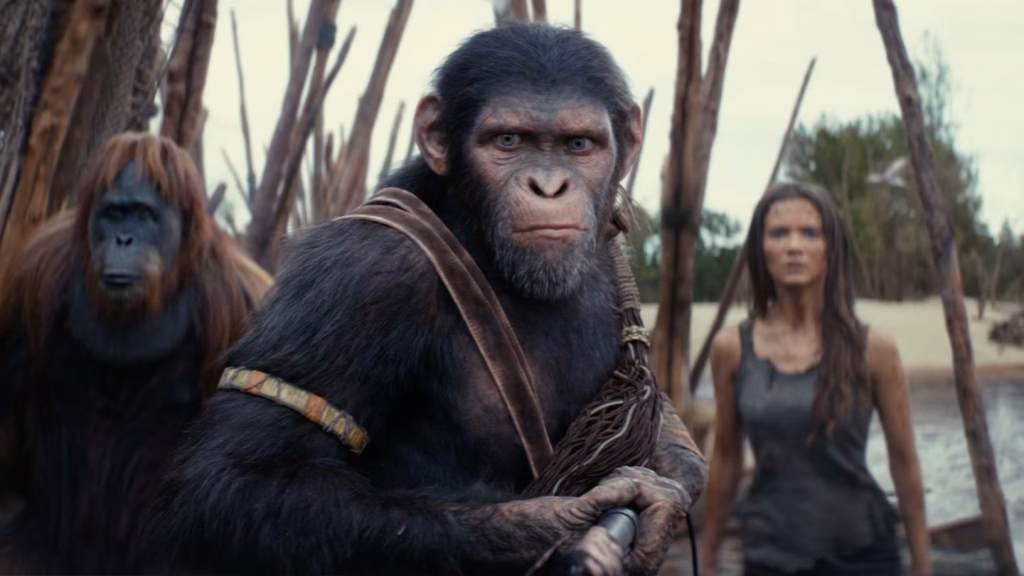
The characters, while all performed well, are basic archetypes. The novice with something to live up to, the wise mentor with connections to the past, the untrustworthy yet necessary sidekick, the true allies that disappear until the third act, the power-hungry villain with a point worth debating. It’s a story that has been told and retold time and time again (anyone who has seen Star Wars knows the hero’s journey), but what separates the great from the middling is how the writer molds the story, how the film plays with or subverts the beats. There is nothing of that sort in Kingdom, even though there was plenty of that in the Caesar Trilogy. The closest the film gets to having an interesting twist on anything story-related comes near the end with Noa and Mae, but more than anything else, it’s a conversation that reeks of sequel fodder. If this film does well and sequels are made, it’s not hard to imagine that they will be far more interesting than Kingdom, but that’s not an excuse for generic writing. Rise had to do the same world-building work as Kingdom, and did so in a far more interesting way.
While the visual effects are astounding, the rest of the technical elements aren’t overly impressive. The cinematography is nice, but there aren’t any particularly memorable shots. The editing keeps the pace up in the first half quite well, but it starts to drag somewhat in the second half and especially the last act. The music is very generic as a typical action movie score. Unfortunately, there isn’t really anything about Kingdom that makes it a must-watch beyond its technical elements. Had the previous Apes films set the bar of quality to “visual spectacle,” then this would probably be just as serviceable as the others, but they haven’t. The previous Apes films have been much deeper meditations on the nature of humanity and what happens when they are no longer the dominant species on the planet, as well as looking at what it meant for the apes themselves to evolve. It balanced both of these factions in very nuanced ways, and managed to never be dull. They were thoughtful movies, and even though Kingdom tries to be thoughtful, it cannot overcome the desire to revert back to basics.

Kingdom of the Planet of the Apes is not a terrible movie by any stretch of the imagination. It’s evident that a lot of care went into the production of it, and every cent of its budget is onscreen to witness. But in a franchise that started out as such a risk, it’s hard not to feel let down by a story so by-the-numbers. The Caesar Trilogy needed to be good in a way that few trilogies do; they carried the weight of a near-dead franchise throughout the entire run, and it was only by the conclusion of War that audiences were ready to accept it as repentance for the Burton reboot. The franchise promised a foray into deeper themes and more complicated stories after Caesar, and for this second of a planned three trilogies to begin on such a generic note does not bode well for what is to come. Hopefully, the ending of Kingdom will propel the franchise to explore uncovered ground, but as a whole, it never comes close to the greatness that this franchise has been and could be.

Leave a Reply